
Scaling Future with Innovation
8. Why Now Is the Startup Moment: Speedboats in an Ocean of Tankers
Yvonne Winter · CEO, FlyNow · November 6, 2026
Download PDF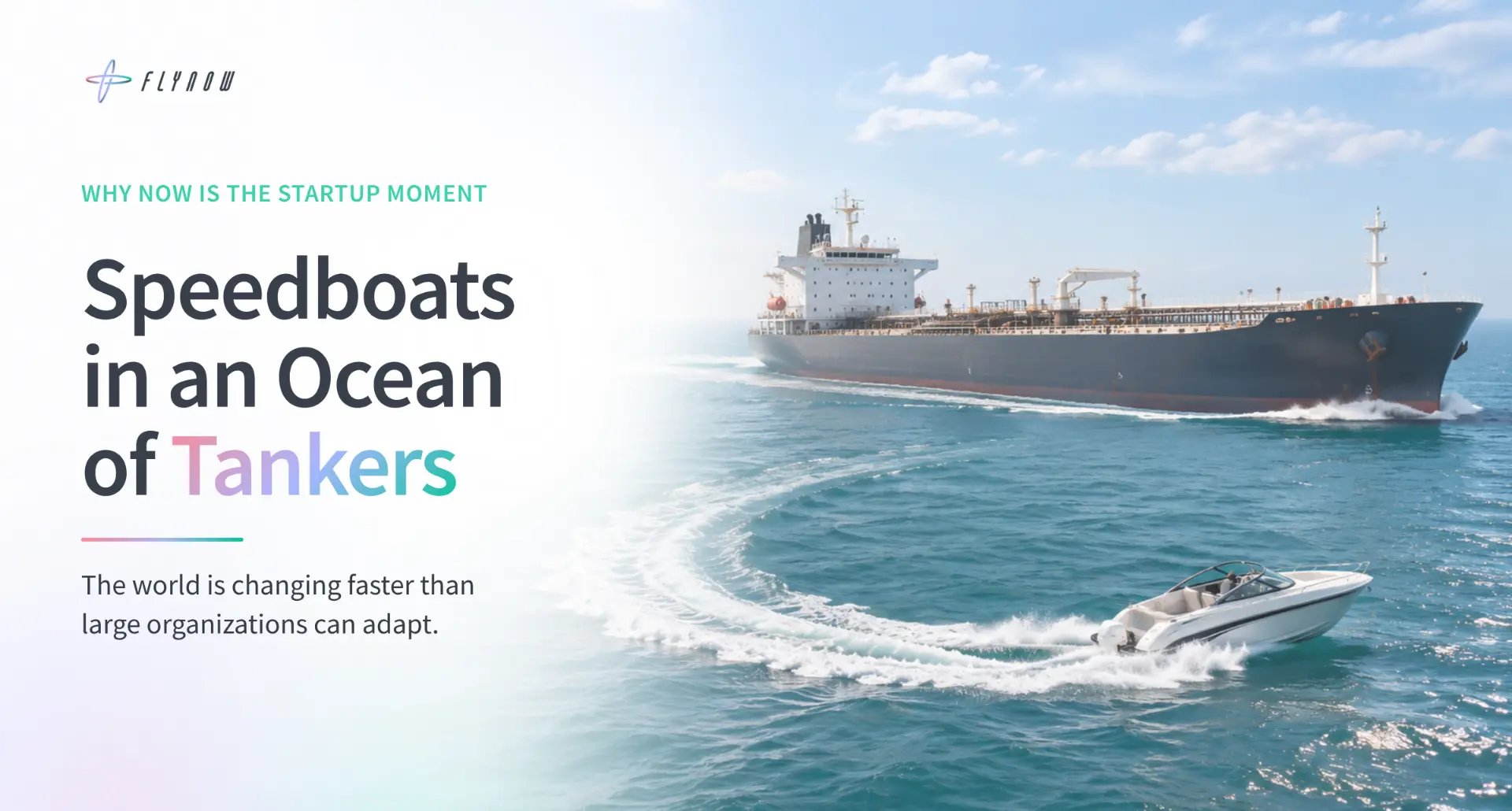
The world is changing faster than large organizations can adapt. That's not a problem-it's an opportunity.
The Great Inversion
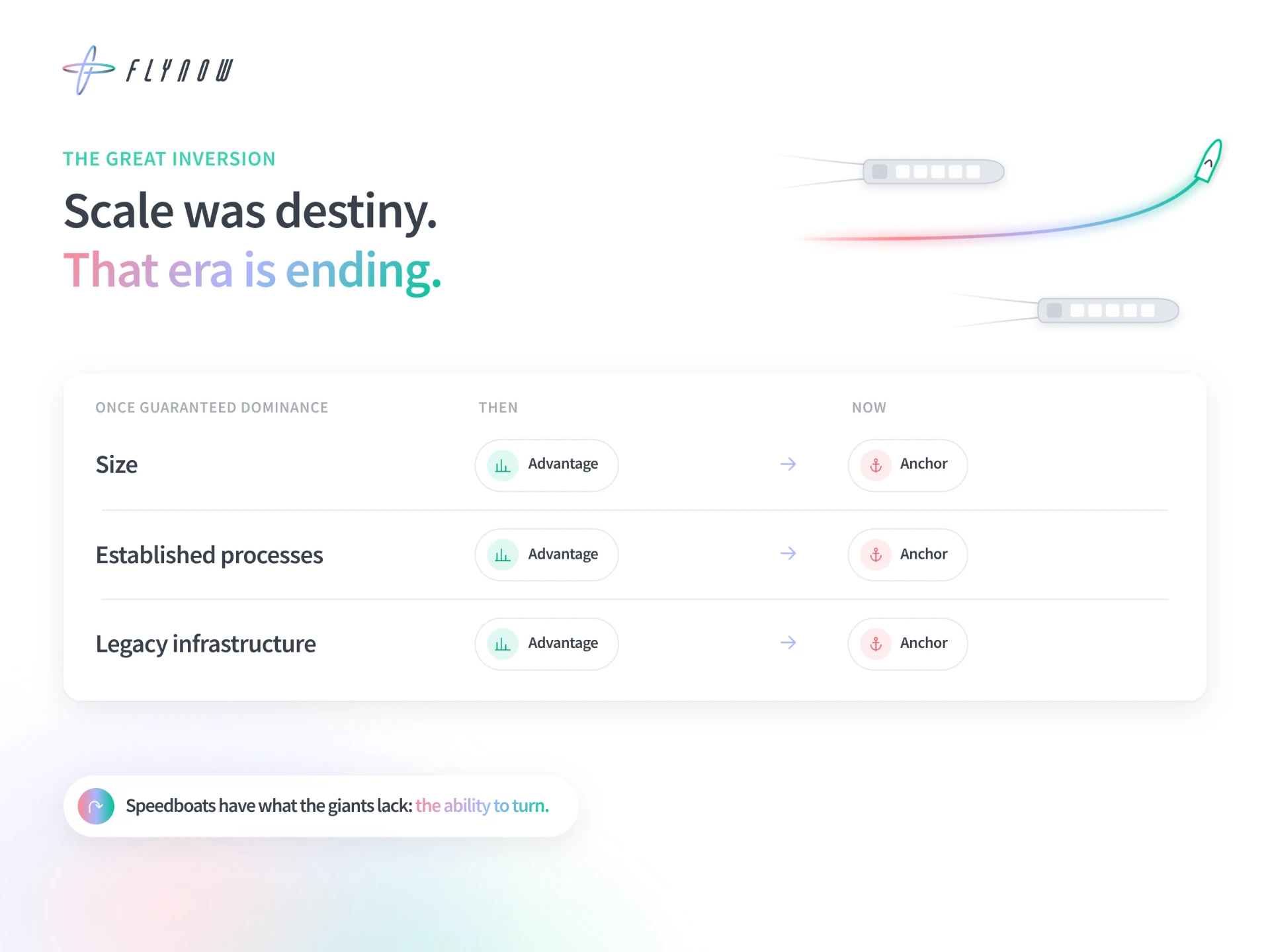
For decades, scale was destiny. The largest corporations commanded the most resources, attracted the best talent, and shaped entire industries through sheer gravitational pull. They were tankers: massive, powerful, seemingly invincible as they crossed the economic oceans.
That era is ending.
We are living through a transformation so profound that the very attributes that once guaranteed corporate dominance - size, established processes, legacy infrastructure - have become anchors dragging organizations toward irrelevance. The tankers haven't stopped moving, but they're discovering that in waters this turbulent, their mass is no longer an advantage. It's a liability.
Meanwhile, startups - the speedboats - are navigating the same storms with something the giants lack: the ability to turn.
The Tanker's Dilemma
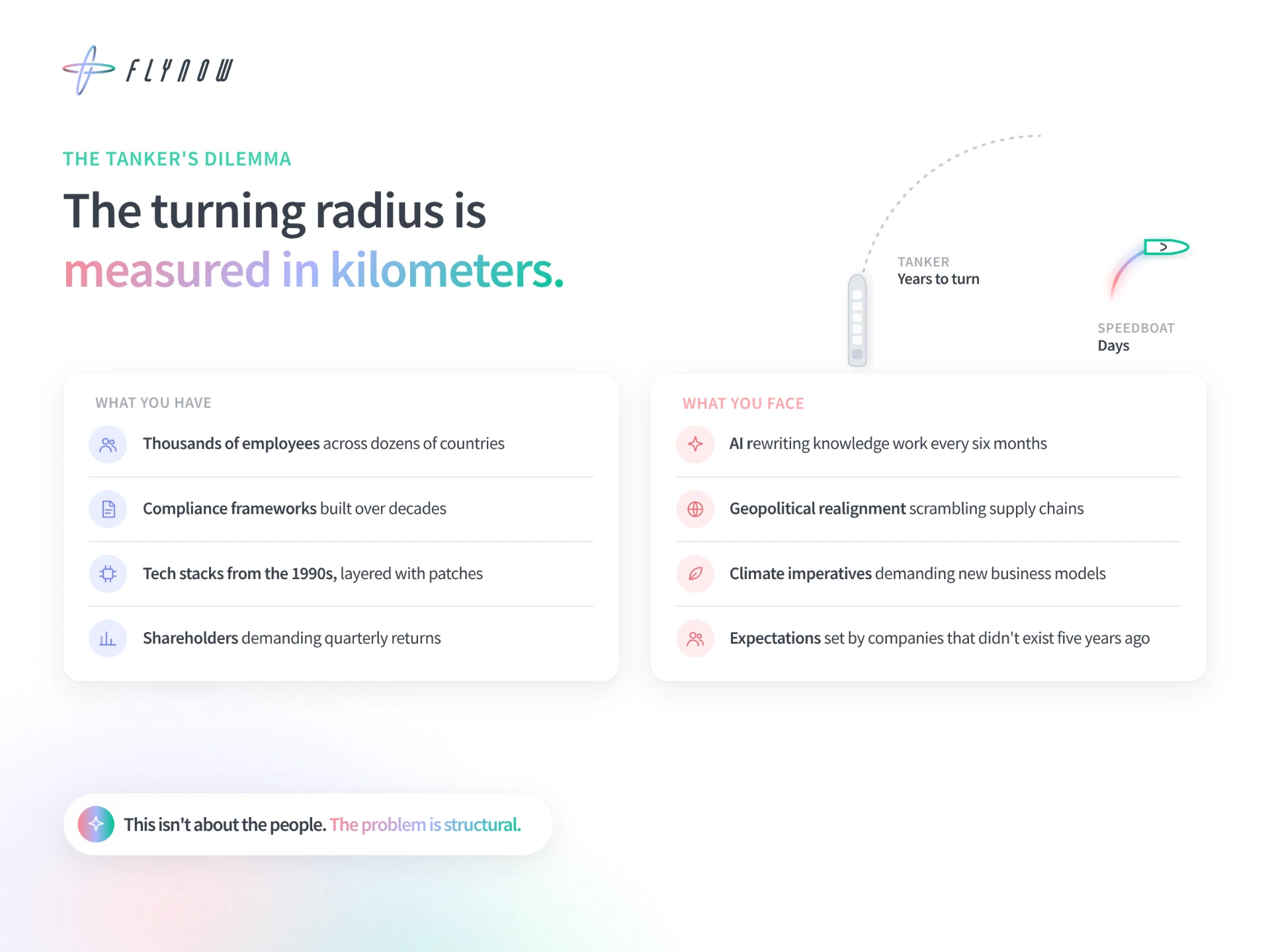
Consider what it means to be a large corporation in 2026. You have thousands of employees distributed across dozens of countries. You have compliance frameworks built over decades. You have technology stacks that began in the 1990s, layered with patches and workarounds. You have shareholders demanding quarterly returns, boards demanding risk mitigation, and middle management demanding that nothing change too quickly.
Now consider what you're facing: artificial intelligence that rewrites the rules of knowledge work every six months. Geopolitical realignment that scrambles supply chains overnight. Climate imperatives that demand complete reinvention of business models. Consumer expectations shaped by experiences from companies that didn't exist five years ago.
A tanker can carry more cargo than a thousand speedboats. But when an iceberg appears - or when the destination itself shifts - the tanker's captain faces a terrible mathematics. The turning radius is measured in kilometers. The time to change course is measured in years. And by the time the new heading is set, the world has moved again.
This isn't a criticism of the people inside these organizations. Many are brilliant, capable, and fully aware of the challenges they face. The problem is structural. Large corporations were designed for a world of predictable change - incremental improvements, gradual market shifts, decade-long planning horizons. That world no longer exists.
The Speedboat's Advantage
A startup is defined not by its size but by its relationship to uncertainty. Where corporations see risk to be managed, startups see problems to be solved. Where corporations ask "how do we protect what we have," startups ask "what should exist that doesn't yet."
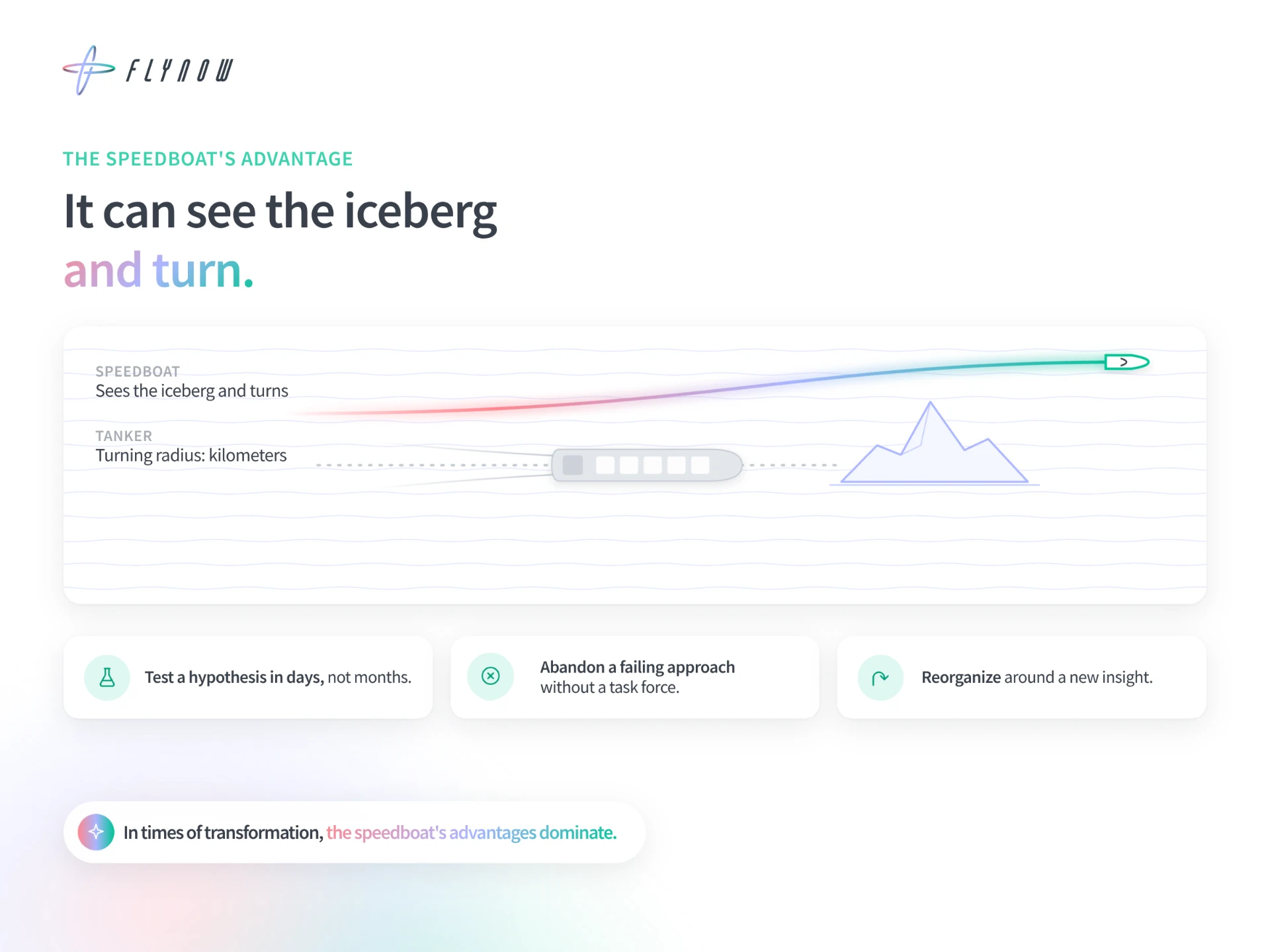
This isn't about being reckless. The best startups are deeply methodical - but their methods are built for speed. They can test a hypothesis in days, not months. They can abandon a failing approach without convening a task force. They can reorganize around a new insight without restructuring entire divisions.
The speedboat doesn't carry as much cargo. It doesn't have the fuel reserves for endless journeys. But it can see the iceberg and turn. It can find the new route while the tanker is still debating whether the old maps are wrong.
In times of stability, the tanker's advantages dominate. In times of transformation, the speedboat's advantages dominate. Look around at 2026. Which time are we living in?
The Uncertainty Landscape
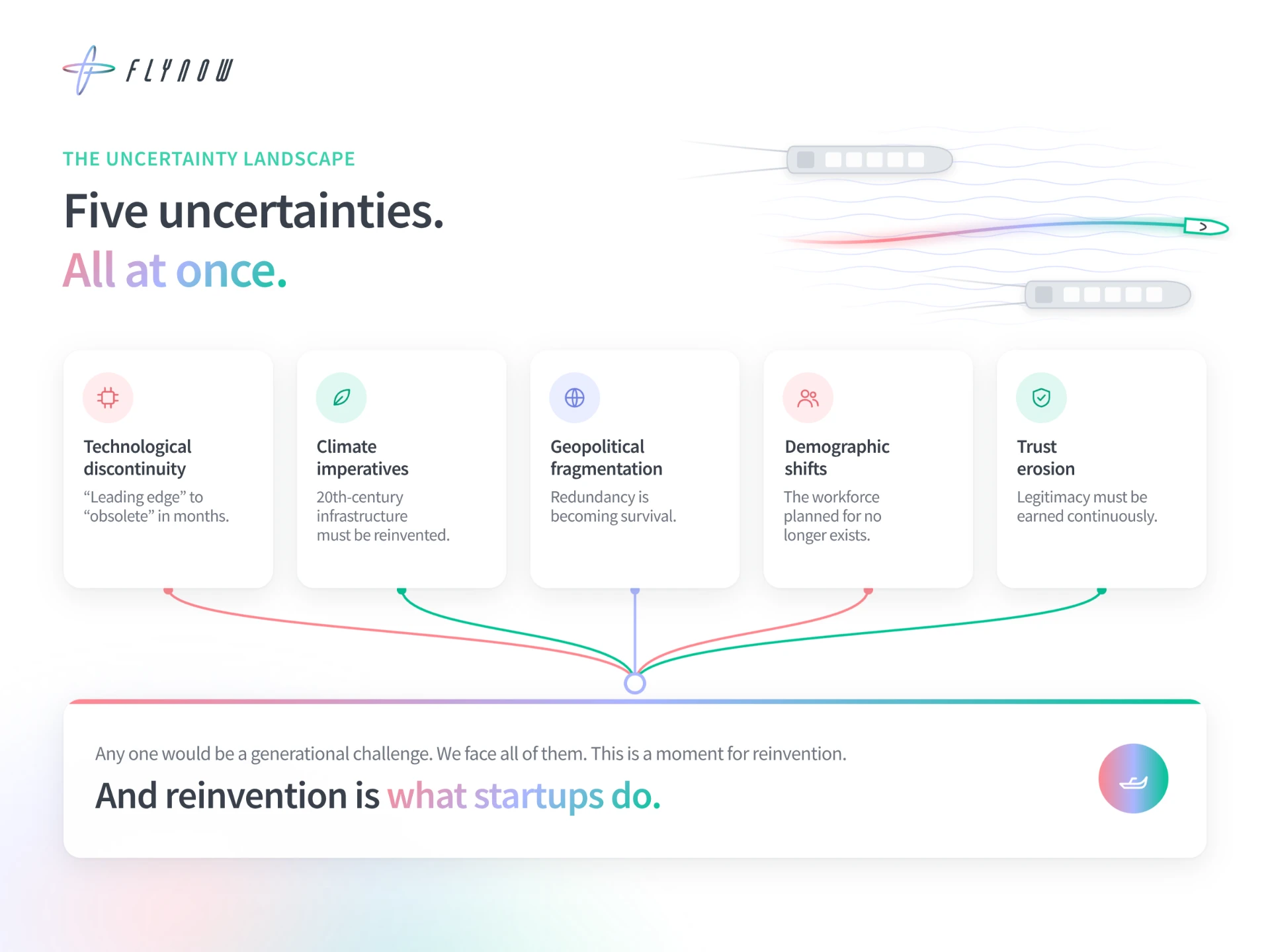
Let us be honest about what we face. The uncertainties of our moment are not ordinary business challenges - they are fundamental questions about how human civilization will organize itself in the coming decades.
Technological discontinuity: Artificial intelligence is not merely improving existing processes; it is making entire categories of work obsolete while creating categories that didn't exist. The gap between "leading edge" and "obsolete" has compressed from decades to months.
Climate imperatives: The physical infrastructure of the 20th century - built on assumptions of cheap fossil energy and stable climate patterns - must be reinvented. This is not a regulatory burden; it is a complete reimagining of how we move, build, produce, and consume.
Geopolitical fragmentation: The globalized supply chains that enabled the efficiency of large corporations are splintering along new fault lines. Redundancy, once seen as waste, is becoming survival.
Demographic shifts: Aging populations in developed economies, youth bulges in developing ones, migration patterns reshaping cities - the workforce and customer base that corporations planned for is not the workforce and customer base that exists.
Trust erosion: Institutions that once commanded automatic credibility - governments, corporations, media - now face skepticism as the default. Legitimacy must be earned continuously, not inherited.
Any one of these would be a generational challenge. We face all of them simultaneously. This is not a moment for incremental adaptation. This is a moment for reinvention.
And reinvention is what startups do.
The New Definition of Success: Be the Solution
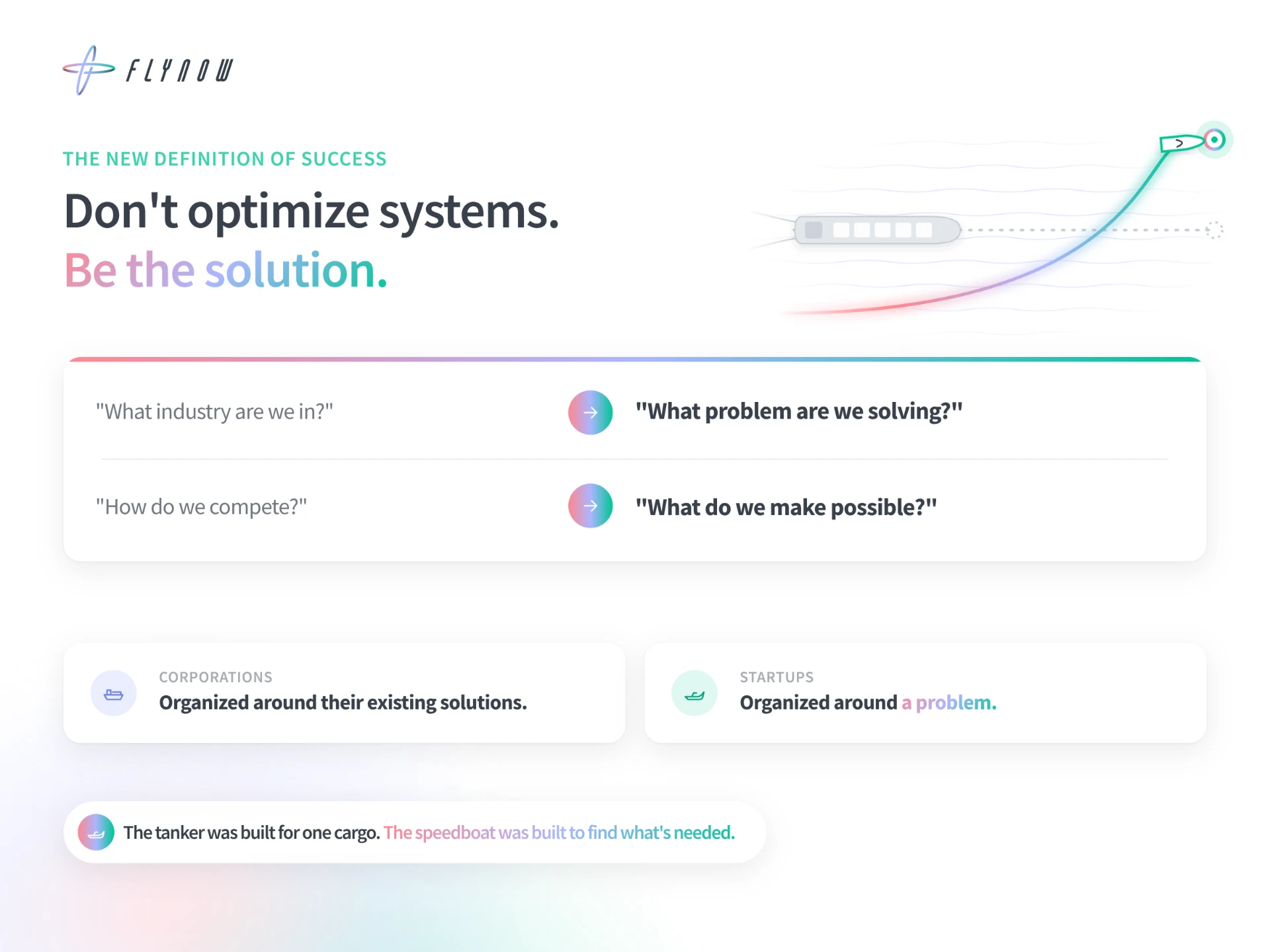
Here is the shift that matters most: the successful businesses of the coming decades will not be those that optimize existing systems. They will be those that solve the problems those systems cannot.
This is more than a change in strategy. It is a change in identity. The question is no longer "what industry are we in" but "what problem are we solving." The question is no longer "how do we compete" but "what do we make possible that was impossible before."
This is where startups have a structural advantage that goes beyond agility. Startups are, by definition, organized around a problem. They exist because their founders looked at the world, saw something broken or missing, and decided to fix it. That clarity of purpose - that obsession with a specific solution to a specific problem - is their competitive essence.
Large corporations, by contrast, are organized around their existing solutions. Their identity is tied to what they already do, what they already sell, what they've already built. When the problems change, they face an existential question: are we the solution to what matters now, or are we a legacy of what mattered before?
The tanker was built for a specific cargo, a specific route, a specific era. The speedboat was built to find what's needed and deliver it.
FlyNow and Salaam.earth: Building the Mobility Ecosystem
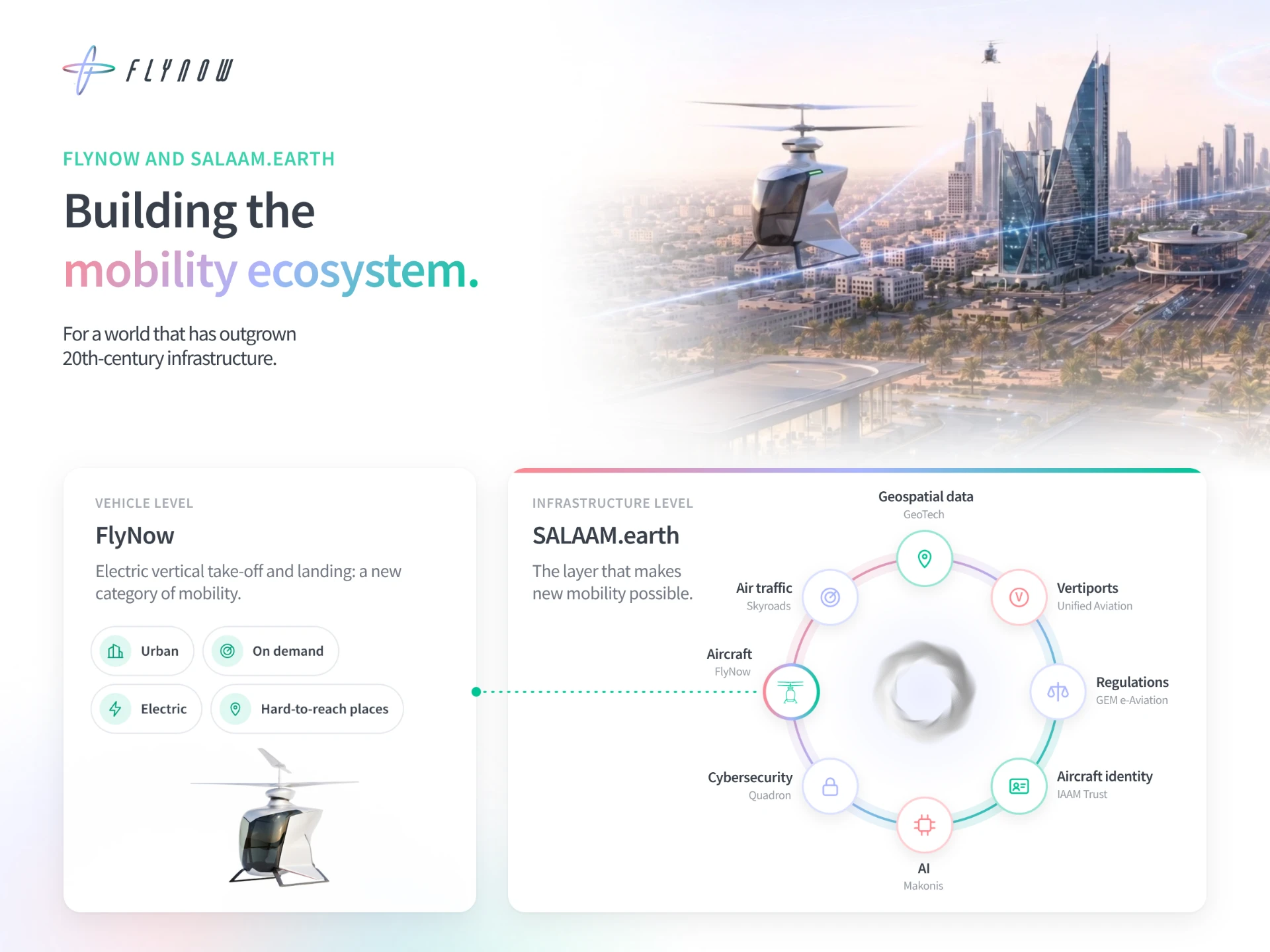
This brings me to what we are building with FlyNow and Salaam.earth - not as isolated ventures, but as interconnected pieces of a larger vision.
The problem we are solving is not merely "how do people get from one place to another." That question has answers - answers that are failing. Urban congestion that costs billions in lost productivity. Aviation infrastructure designed for a world of hub-and-spoke airlines, not distributed mobility. Carbon emissions from transportation that make climate targets unreachable. Connectivity that leaves vast regions economically stranded.
The problem we are solving is: how does mobility work in a world that has outgrown 20th-century infrastructure?
FlyNow addresses this at the vehicle level. Electric vertical takeoff and landing aircraft are not simply new aircraft - they are a new category of mobility. They operate where traditional aviation cannot: in urban environments, in distributed networks, in patterns that follow demand rather than forcing demand to follow fixed routes. They run on electricity, not jet fuel. They can land where helicopters cannot and reach places that roads will never connect economically.
But a vehicle alone is not a solution. A car without roads is a curiosity. An aircraft without an ecosystem - without infrastructure, without integration, without the systems that connect it to the broader mobility landscape - is a technology demonstration, not a transformation.
This is where Salaam.earth enters. We are building the infrastructure layer that makes new mobility possible: the vertiports, the charging networks, the traffic management systems, the regulatory frameworks, the integration with ground transportation. We are not building for one vehicle or one operator. We are building an ecosystem that enables an entire new category of mobility to function, scale, and serve the people who need it.
This is the startup advantage made concrete. We are not trying to retrofit existing infrastructure. We are not negotiating with legacy systems that were designed for different vehicles, different patterns, different eras. We are building from first principles: what does mobility need to look like, and what infrastructure makes that possible?
The Ecosystem Imperative
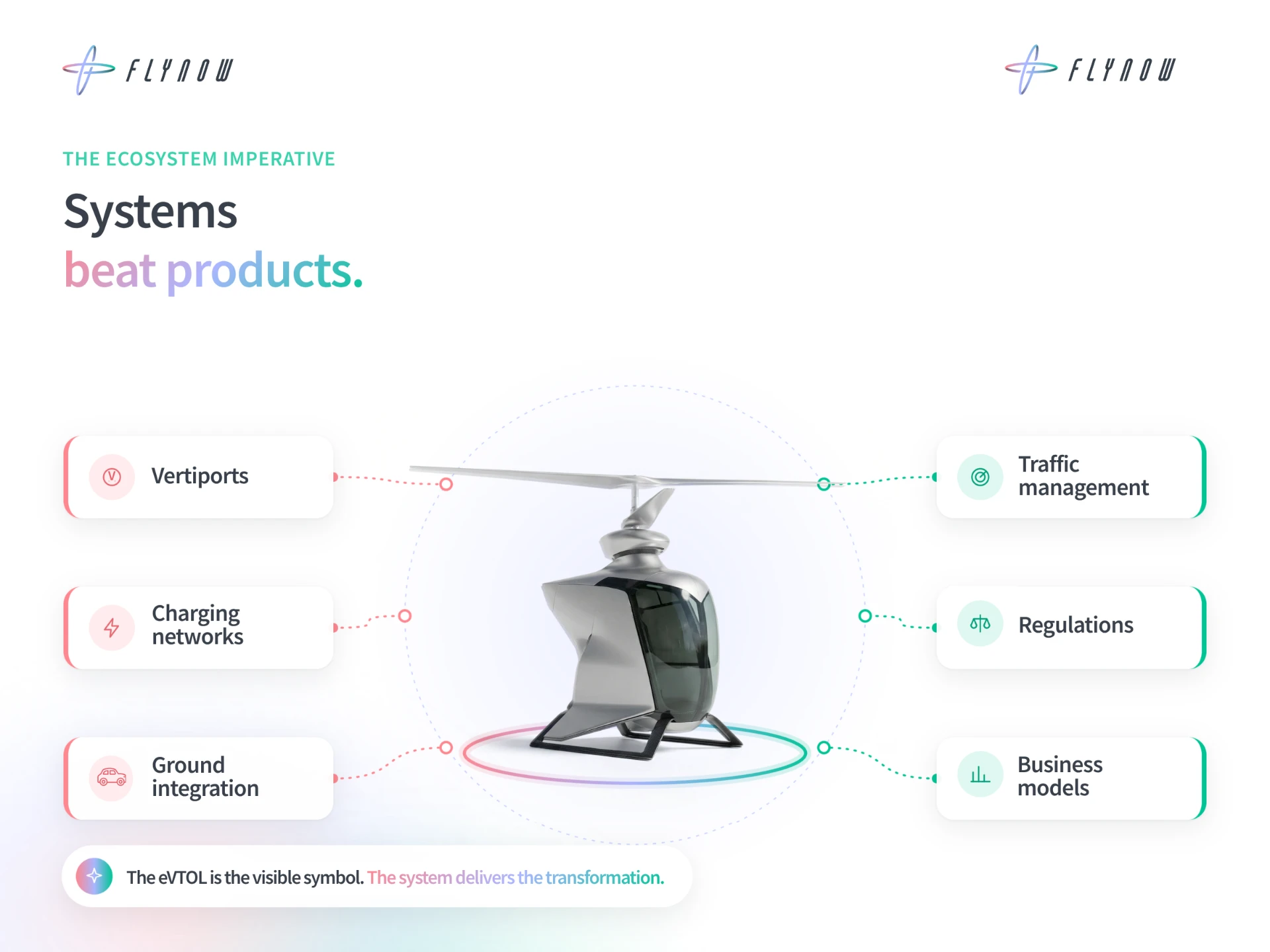
There is a reason I speak of FlyNow and Salaam.earth together, as parts of a single ecosystem. The lesson of every transformational technology is that systems beat products.
The automobile did not transform the world alone. Roads, gas stations, traffic laws, insurance systems, suburban development patterns, shopping malls, drive-through restaurants - an entire ecosystem emerged around the core technology. The companies that thrived were not always those with the best cars. They were those that understood and built the ecosystem.
The same will be true for the next era of mobility. The eVTOL vehicle is the visible symbol, but the transformation will be delivered by the system: the infrastructure that supports it, the regulations that enable it, the integration that makes it seamless, the business models that make it accessible.
We are building that system. Not as an afterthought to vehicle development, but as a parallel track. Not as a single company trying to do everything, but as coordinated ventures each focused on their piece of the puzzle, designed from the start to work together.
This is what "be the solution" means in practice. It means thinking not about what you sell but about what you enable. It means building not products but capabilities. It means solving not isolated problems but creating the conditions where problems stay solved.
When Tankers Support Speedboats
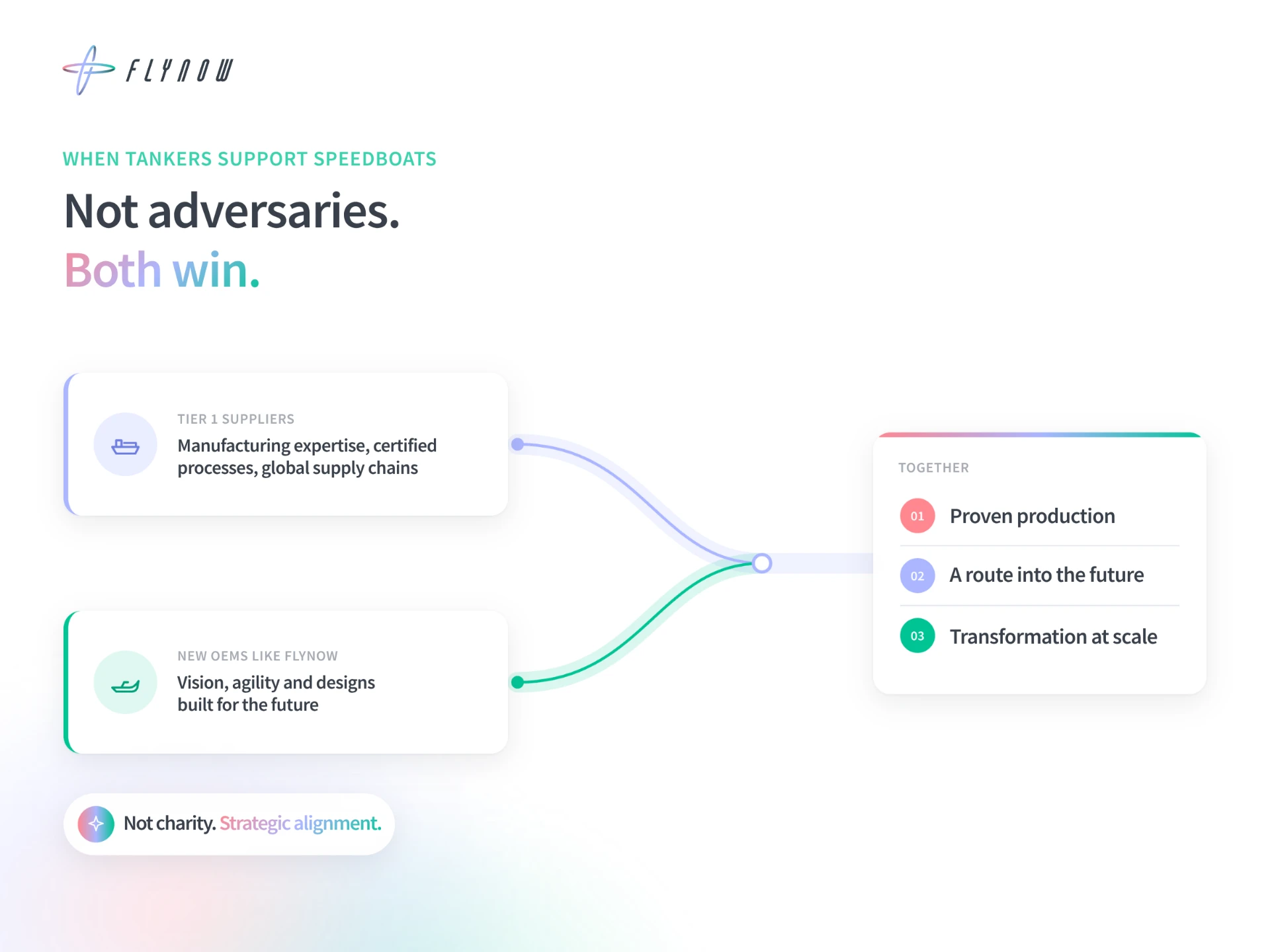
But here is what I believe most strongly: tankers and speedboats need not be adversaries. There is a powerful case for tankers actively supporting speedboats - and when they do, both win.
Consider the Tier 1 suppliers - the established giants of the automotive and aerospace industries. They possess decades of manufacturing expertise, certified production processes, global supply chains, and deep engineering knowledge. These are not assets to be discarded. They are assets waiting for the right application.
New OEMs like FlyNow bring vision, agility, and designs built for the future rather than inherited from the past. But we also face the challenge of scaling production, navigating certification, and building manufacturing capability from scratch. This is where the tankers have sailed for decades.
When Tier 1 suppliers partner with new OEMs, the mathematics change entirely. The speedboat gains access to proven manufacturing capability, established quality systems, and supply chain depth that would take years to build independently. The tanker gains a route into the future - a way to deploy their capabilities in markets that their own product roadmaps cannot reach.
This is not charity. This is not corporate social responsibility. This is strategic alignment. The Tier 1 supplier who helps a new OEM succeed is not just earning a contract - they are earning a position in the next industrial era. They are transforming their tanker's cargo hold into a launchpad for speedboats.
The best futures are built together. When tankers support speedboats, when established expertise empowers emerging innovation, we create something neither could achieve alone: transformation at scale.
An Invitation
The transformation underway is not a spectator sport. The uncertainties we face will not be resolved by waiting for clarity. Clarity will come from action - from the startups and founders and builders who look at the chaos and see not danger but invitation.
The tankers will not disappear overnight. They will lumber on, carrying their cargo, maintaining their routes, managing their decline. Some will find ways to become more agile, to spin out speedboats of their own, to reinvent themselves before it's too late.
But the future will not be built by managing decline. It will be built by those who see the problems clearly and commit to solving them. It will be built by speedboats - nimble, focused, obsessed with the destination rather than attached to the route.
FlyNow and Salaam.earth are our contribution to that future. We are building the infrastructure for a world that moves differently - more sustainably, more efficiently, more equitably. We are building it now, while the tankers debate whether change is coming.
The change is here.
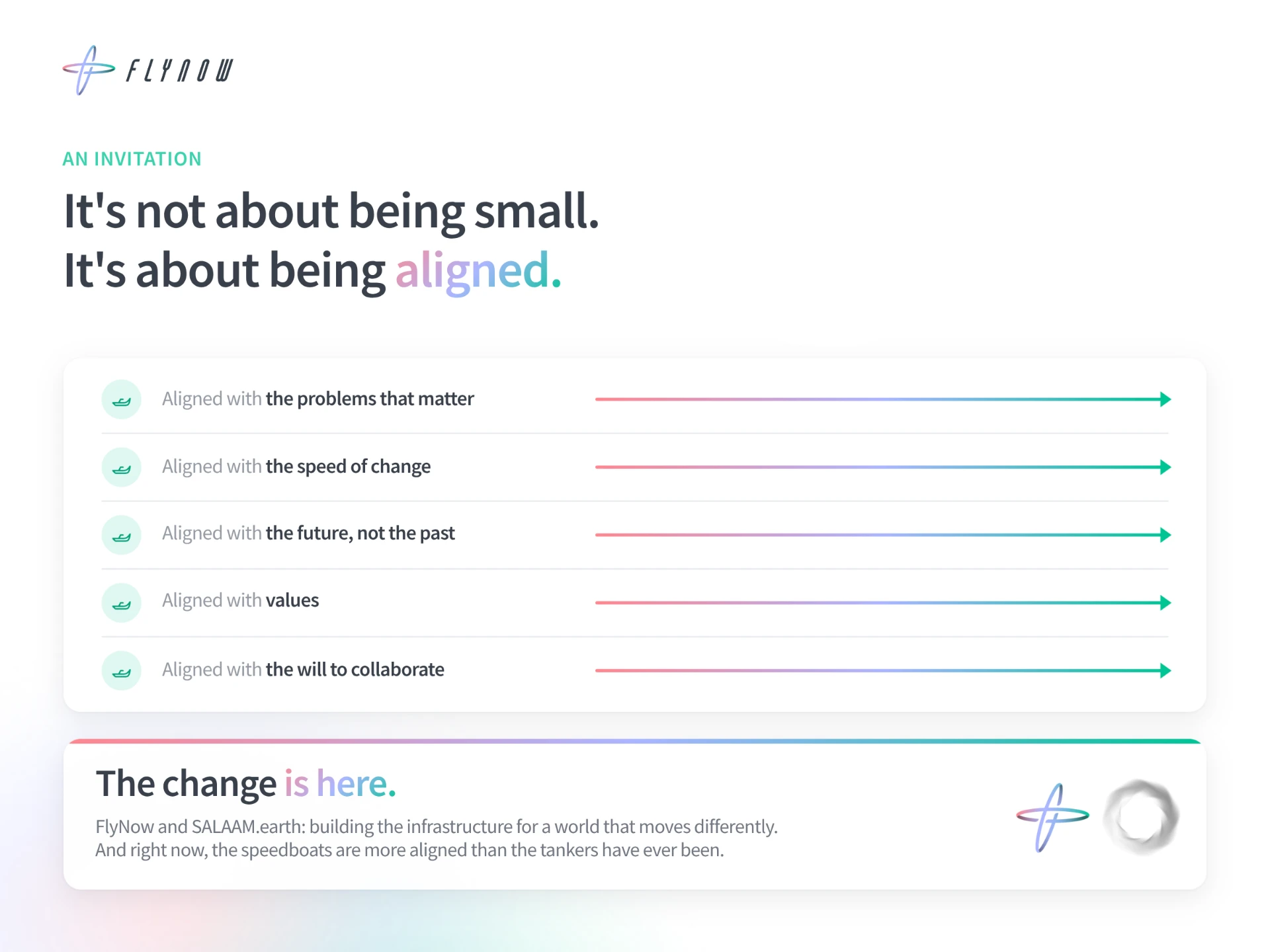
The startup moment is not about being small. It is about being aligned: aligned with the problems that matter, aligned with the speed of change, aligned with the future rather than the past, aligned with values, aligned on the will to collaborate. In a world of transformation and uncertainty, alignment is everything. And right now, the speedboats are more aligned than the tankers have ever been.